Artemis II Launch Day: Key Milestones and Updates
By Jason Costa
AI Summary
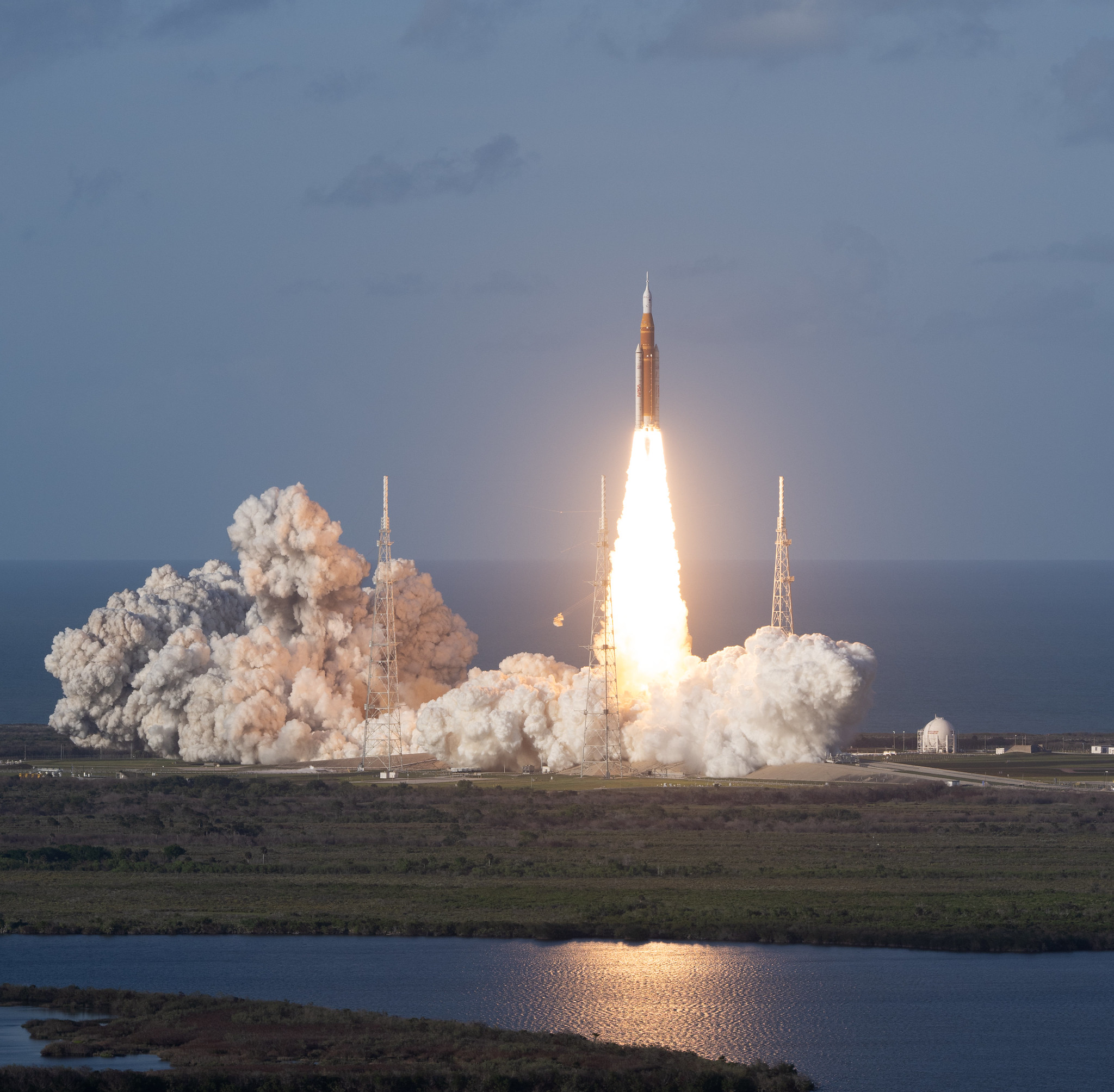
Today marks a monumental step in NASA's Artemis program as Artemis II, the first crewed mission, embarks on its journey around the Moon. At 6:35 p.m. EDT, the Space Launch System (SLS) rocket, with the Orion spacecraft atop, lifted off from Kennedy Space Center, carrying NASA astronauts Reid Wiseman, Victor Glover, and Christina Koch, along with Canadian astronaut Jeremy Hansen. This mission aims to test critical systems and operations in deep space, paving the way for future lunar landings and Mars exploration.
The launch sequence began with the ignition of the twin solid rocket boosters, providing the majority of the thrust needed to lift the 5.75-million-pound rocket. As the rocket ascended, the umbilicals retracted, ensuring the vehicle was free from ground systems. Shortly after, the solid rocket boosters separated, followed by the jettisoning of the spacecraft adapter fairings, as the rocket soared above the densest layers of Earth's atmosphere.
After the main engine cutoff of the SLS core stage, it successfully separated from the interim cryogenic propulsion stage and the Orion spacecraft. This transition marked the end of the first major propulsion phase, setting the stage for the deployment of the solar array wings (SAWs). These wings, extending from the European Service Module, provide continuous electrical power to the spacecraft, supporting life-support systems and onboard operations.
As the mission progresses, the next significant maneuvers include the perigee raise maneuver (PRM) and apogee raise burn (ARB), which will adjust the spacecraft's orbit in preparation for deep-space operations. Following these burns, the Artemis II crew will conduct a proximity operations demonstration, testing Orion's ability to manually maneuver relative to another spacecraft.
Throughout the day, meticulous preparations ensured the mission's success. The countdown involved a series of automated commands orchestrated by the ground launch sequencer, transitioning systems from ground to flight mode. The closeout crew played a crucial role, assisting astronauts with suit-up and hatch closure, ensuring airtight seals and communication readiness.
The launch was preceded by a series of checks and balances, including resolving an issue with the flight termination system and ensuring all safety systems were operational. Weather conditions were favorable, with a 90% go for launch, further supporting the mission's timeline.
The Artemis II mission is not just a test flight; it represents a significant leap forward in human space exploration. By sending astronauts farther from Earth than ever before, NASA is setting the stage for future missions that will explore more of the Moon and eventually Mars. This mission is a testament to years of planning, testing, and the relentless pursuit of discovery.
Key Concepts
The Space Launch System (SLS) is NASA's advanced launch vehicle designed to carry astronauts and cargo beyond Earth's orbit, specifically for missions to the Moon and Mars. It is the most powerful rocket ever built, capable of delivering unprecedented payloads to deep space.
The Orion spacecraft is NASA's next-generation crew vehicle designed for deep space exploration. It is equipped to carry astronauts on missions beyond low Earth orbit, including trips to the Moon and eventually Mars.
Category
Space ExplorationMore on Discover
Summarized by Mente
Save any article, video, or tweet. AI summarizes it, finds connections, and creates your to-do list.
Start free, no credit card