A Day in the Life of Firing America's Powerful Laser
By The Conversation
AI Summary
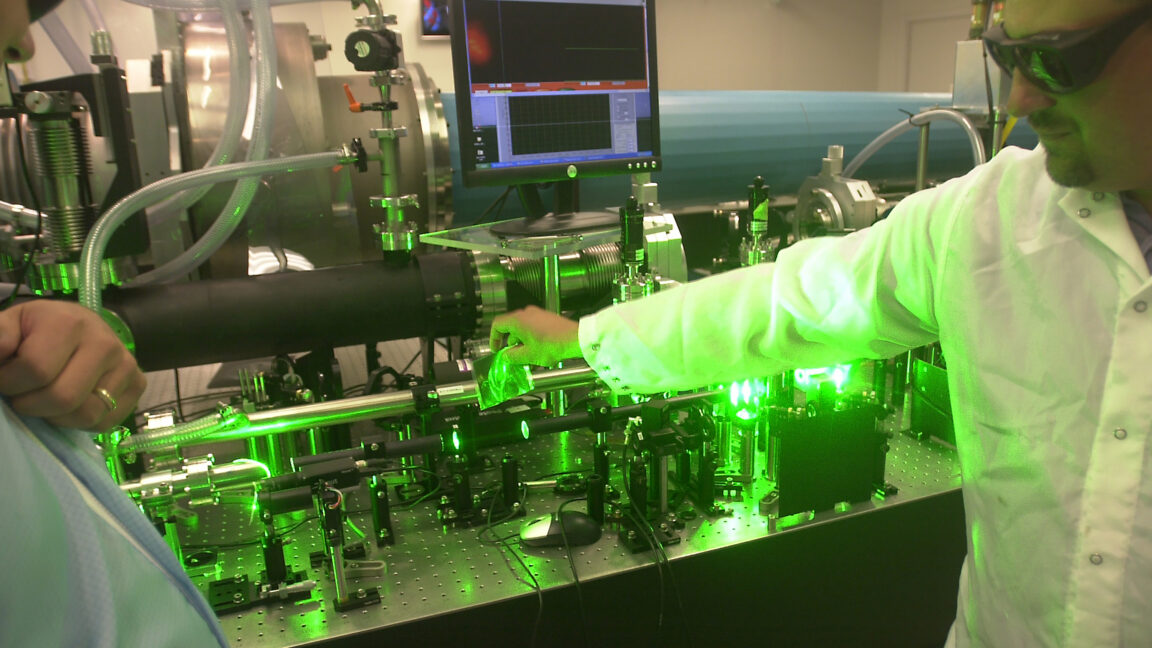
Beneath the University of Texas at Austin lies one of America's most powerful lasers, the Texas Petawatt. As the lead laser scientist from 2020 to 2024, I had the privilege of orchestrating the intricate dance of light and energy that defines a 'shot day.' This laser, part of the LaserNetUS network, was a hub for groundbreaking research, from probing stellar interiors to exploring fusion energy and even cancer treatment innovations.
The day begins early, with meticulous preparation in the cold clean room. I don my gown and boots, ready to coax the laser into life. The process starts with an oscillator, setting the parameters that will dictate the laser's behavior. This tiny pulse of light is amplified through a series of stages, each more powerful than the last, until it carries more power than the entire US electrical grid for a brief moment.
As the beam travels through amplifiers, it absorbs energy, growing stronger with each pass. This is a delicate process, requiring constant alignment checks to avoid catastrophic misalignments. The final stage involves massive glass disks, charged by capacitors that release energy in a sudden burst, readying the laser for its moment of glory.
When the experimental team signals readiness, I prepare for the system shot. The facility enters 'System Shot Mode,' and I ensure no one remains in the laser's path. With all systems go, I charge the capacitors, and the room falls silent. The tension is palpable as I press the button, unleashing the laser's power.
The shot itself is a fleeting moment, but its impact is profound. The laser creates temperatures hotter than the Sun's surface, providing invaluable data for researchers. However, not every attempt is successful. Equipment failures can lead to hours of waiting and retrying, a testament to the patience and precision required in this field.
Despite the challenges, the thrill of those ten seconds makes it all worthwhile. Beneath the bustling campus, a world of scientific wonder unfolds, pushing the boundaries of what we know about the universe.
Key Concepts
A petawatt laser is a type of high-power laser that can deliver pulses of light with a power level of one petawatt (10^15 watts). These lasers are used in scientific research to simulate extreme conditions, such as those found in stellar interiors.
Laser amplification is the process of increasing the power of a laser beam by passing it through a medium that adds energy to the beam. This is typically achieved through a series of amplifiers that boost the beam's energy at each stage.
Category
ScienceOriginal source
https://arstechnica.com/science/2026/04/ive-fired-one-of-americas-most-powerful-lasers-heres-what-a-shot-day-looks-like/More on Discover
Summarized by Mente
Save any article, video, or tweet. AI summarizes it, finds connections, and creates your to-do list.
Start free, no credit card