Ancient Weapons in Modern Immunity: The Evolutionary Battle Between Bacteria and Viruses
By By Viviane Callier April 15, 2026
AI Summary
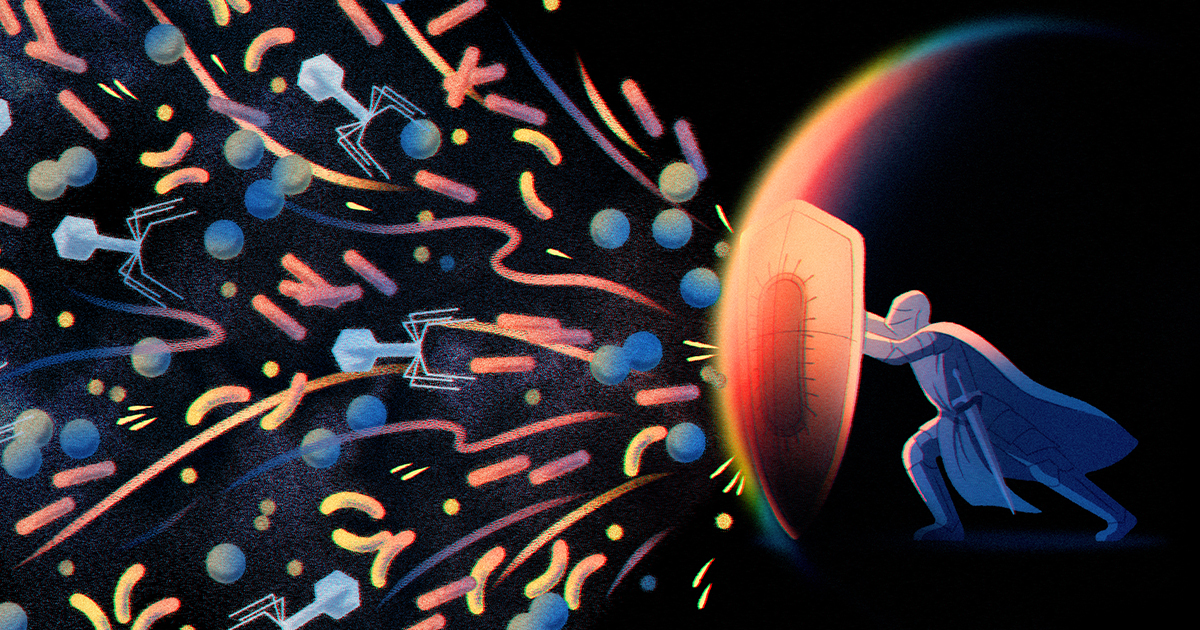
For billions of years, an evolutionary arms race has raged between bacteria and the viruses that infect them, known as phages. This relentless battle has led to the development of sophisticated defense mechanisms in bacteria, some of which are surprisingly similar to those found in human immune systems today. Recent discoveries reveal that the machinery bacteria use to fend off phages is also present in our cells, suggesting that the rules of host-virus interactions have remained largely unchanged over eons. This revelation has opened up new avenues for understanding human immunity and potential medical innovations.
## Defense Islands
Initially, biologists knew of only two bacterial defense mechanisms: restriction-modification enzymes and CRISPR systems. However, research led by scientists like Rotem Sorek has uncovered a plethora of new defense systems clustered in 'defense islands' within bacterial genomes. These discoveries have been accelerated by computational predictions and experimental screenings, revealing hundreds of novel anti-phage systems.
## STING Cycle
A key breakthrough came with the understanding of the cGAS-STING pathway, a crucial part of human innate immunity. This pathway is activated when cGAS detects foreign DNA in the cytoplasm, leading to the production of cGAMP, which then activates the STING protein to trigger an immune response. Remarkably, similar mechanisms were found in bacteria, despite the lack of DNA sequence similarity, highlighting a structural conservation that has persisted through billions of years of evolution.
## Evolutionary Cauldron
The evolutionary interplay between bacteria and phages has led to complex defense and counter-defense strategies. For instance, bacteria have evolved mechanisms like Panoptes to counter phage strategies that disrupt the cGAS-STING pathway. These evolutionary innovations are not static; they continue to evolve, with bacteria serving as a 'maker space' for new molecular weapons.
## Cast of Characters
The discovery of bacterial mechanisms like viperin and gasdermins, which have counterparts in human immunity, underscores the shared evolutionary heritage. These proteins play crucial roles in terminating viral replication and initiating cell death upon infection, respectively. The ongoing research aims to map bacterial immune systems to predict unknown mechanisms in higher organisms, potentially revolutionizing our understanding of immunity.
The evolutionary narrative is further enriched by instances of horizontal gene transfer, where eukaryotes have acquired bacterial genes to enhance their own defenses. This borrowing of rapidly evolving bacterial tools allows multicellular organisms to keep pace with their fast-evolving microbial adversaries. As research continues, the microbial world remains a dynamic source of evolutionary innovation, shaping the immune landscapes of all life forms.
Key Concepts
A process where species develop new traits or strategies to outcompete each other, driving evolutionary changes.
The body's first line of defense against pathogens, consisting of physical barriers and immune responses that are not specific to particular pathogens.
Category
BiologyOriginal source
https://www.quantamagazine.org/the-ancient-weapons-active-in-your-immune-system-today-20260415/More on Discover
Summarized by Mente
Save any article, video, or tweet. AI summarizes it, finds connections, and creates your to-do list.
Start free, no credit card