Building a Pneumatic Segment Display with Air-Powered Logic
By soiboi soft
AI Summary
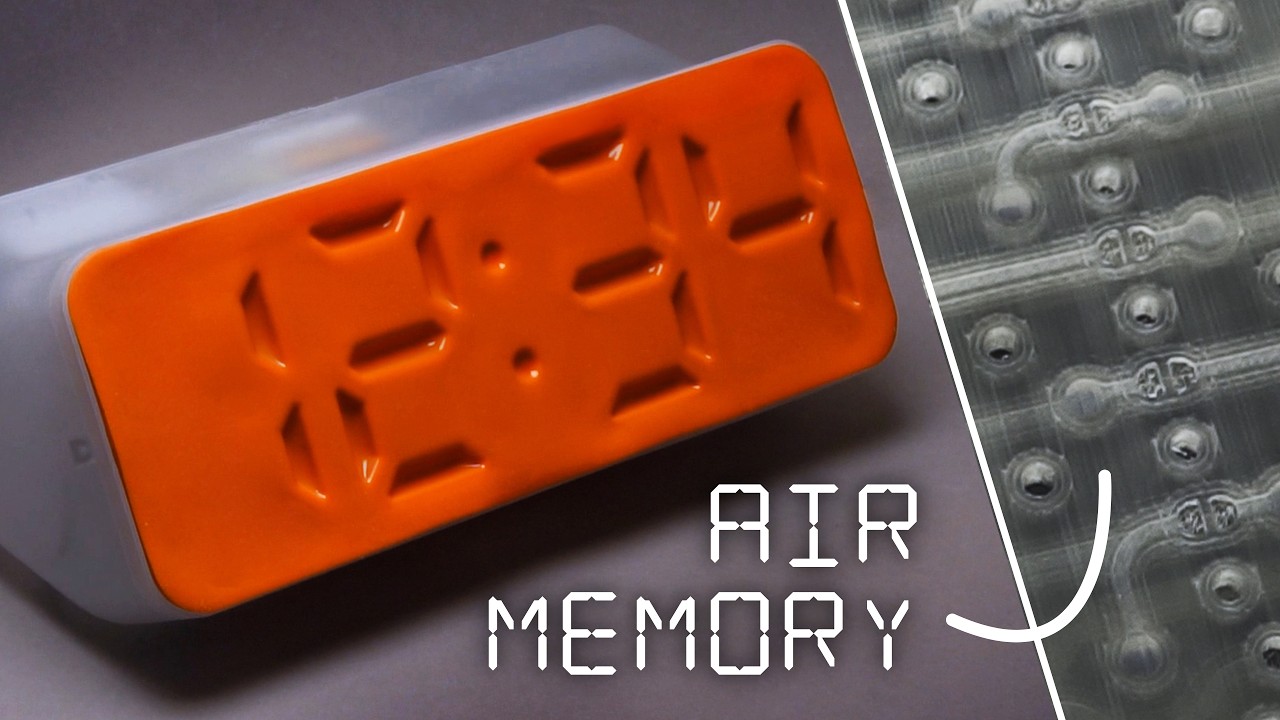
In this project, I explore the fascinating world of air-powered displays, creating a segment display that morphs its silicone skin to show numbers and tell time. The core of this innovation lies in tiny air channels that perform logical operations, leading to the accidental creation of pneumatic RAM. This journey began with air-powered robots and squishy machines, where integrating small air channels into 3D printed bodies allowed for the distribution of pressurized air to their muscles. Inspired by microfluidic circuits, I transitioned from distribution to computation, integrating vacuum-powered transistors and resistors to build logic gates and a ring oscillator powered by a single air flow.
The culmination of this work is an air-powered dot matrix display using multiplexing to control its pixels. Solenoid valves provide specific pressure inputs decoded by microfluidic logic, allowing control of 16 pixels with just eight inputs. Encouraged by suggestions to build a segment display and turn it into a clock, I embraced the challenge. By examining how electronic seven-segment displays work, I adapted their tricks for air, using memory instead of speed to maintain the display's state.
The display's final design features a bright orange membrane in a translucent enclosure, crafted with PCB Way's resin printing services. The segment display functions like the pixels from the dot matrix, with a printed body and a membrane cast in a two-part mold. A critical design element is the clamping frame, which creates a tight seal when screws are tightened, allowing the segment to hold a bit of information as either zero (atmospheric pressure) or one (vacuum).
A vacuum transistor inspired by microfluidics research is key to this design. It opens when vacuum is applied, allowing air to flow across. By connecting the segment and transistor, I built a basic memory cell. This system maintains its state even after removing the input, until a new state is written. The full digit is composed of five layers, forming a 7-bit memory array with pressure inputs entering from the left. The 'right enable' input opens all transistors, writing data to the segments and displaying a number.
To achieve a smooth surface for sealing, I switched to a glass build plate, resulting in a shiny, almost mirror-like finish. The logic membrane is cast using a new technique involving layers of tape and silicone, then cut to shape. The display membrane is thin and delicate, assembled with a clamping frame and main body to seal all segments. Solenoid valves and drivers provide specific pressure inputs, allowing the display to function like its electronic counterpart.
The display can show numbers, letters, and even patterns like 'conveyor' and 'breathing mode'. As a timepiece, it refreshes one digit per second, with blinking dots marking each second. It also functions as a stopwatch and countdown timer. Despite its complexity, the display is a visible memory in action, storing states of atmosphere or vacuum, making it a form of RAM.
This project showcases the potential of pneumatic logic and invites further exploration of what can be achieved with this technology. Let me know what else I should build with this tech, and stay tuned for more innovations.
Key Concepts
Pneumatic logic uses air pressure to perform logical operations, similar to how electronic circuits use electricity. It involves controlling air flow through channels and valves to achieve desired outcomes.
Microfluidic circuits manipulate small volumes of fluids through channels on a micro-scale, often used in biochemical applications for precise control and analysis.
Category
EngineeringOriginal source
https://www.youtube.com/watch?v=E1BLGpE5zH0More on Discover
Summarized by Mente
Save any article, video, or tweet. AI summarizes it, finds connections, and creates your to-do list.
Start free, no credit card