Building an Audio-Reactive LED Strip: A Journey of Innovation and Challenges
AI Summary
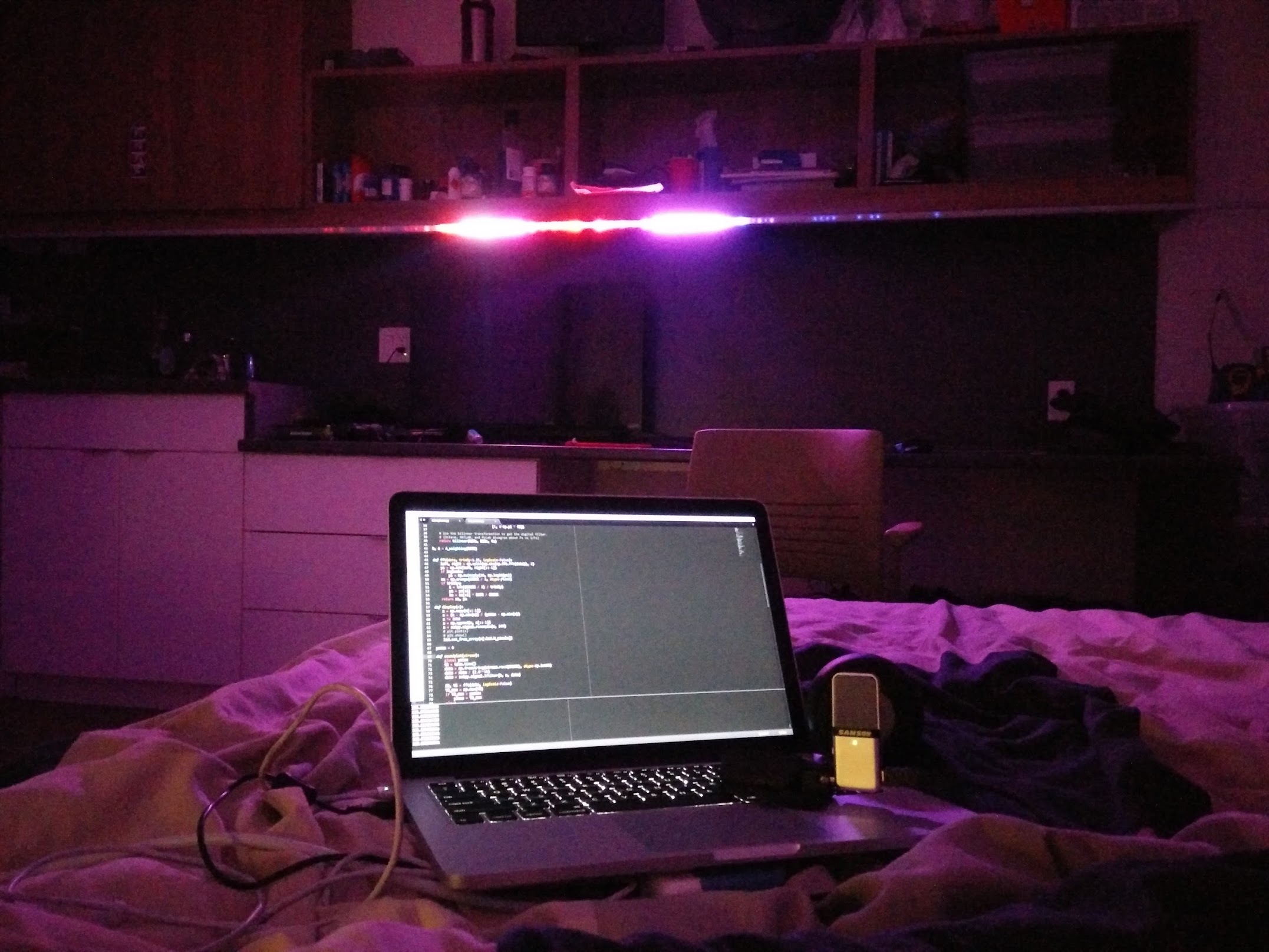
In 2016, I embarked on a journey to create an LED strip that reacts to music in real time. What I thought would be a short project turned into a decade-long adventure, resulting in a popular GitHub project with 2.8k stars and applications ranging from nightclubs to personal electronics projects. Initially, I used non-addressable LED strips, focusing on volume-based brightness adjustments. However, this approach quickly proved limiting, as it failed to capture the rich frequency information of music. To address this, I transitioned to WS2812 addressable LEDs, allowing for more nuanced visualizations.
## The Naive FFT and Pixel Poverty
My first attempt at frequency domain processing involved using a Fourier transform to map audio frequencies to LEDs. While this method captured more audio detail than volume-based approaches, it was unsatisfying due to the limited number of LEDs. This challenge, which I call 'Pixel Poverty,' highlighted the difficulty of creating meaningful visualizations with a small number of pixels. Unlike screen-based visualizers with millions of pixels, LED strips require careful selection of features to display.
## Discovering the Mel Scale
To overcome these limitations, I explored the mel scale, a concept from speech recognition that maps frequencies into a perceptual space. This breakthrough allowed me to map mel-scaled frequency bins to LEDs, resulting in a vibrant and meaningful display. The mel scale transformed my project, making every LED contribute to the visualization.
## Smoothing and Perceptual Models
Despite the success of the mel scale, the visualizations initially flickered due to rapid feature changes. I applied exponential smoothing and convolutions to create smoother transitions, enhancing the visual experience. Additionally, I incorporated gamma correction and color theory to align LED brightness with human perception, further refining the visual output.
## The Final Visualizations
The project culminated in three main visualizations: Spectrum, Scroll, and Energy. Each leverages the mel scale and smoothing techniques to create dynamic and engaging displays. The system operates in real time, balancing latency and responsiveness through a rolling window approach.
## Community and Impact
The project gained unexpected popularity, with contributions from users worldwide who integrated it with platforms like Amazon Alexa and Home Assistant. It became a gateway for many into electronics, and I witnessed its use in diverse settings, from personal projects to nightclub installations.
## Challenges and Future Directions
Despite its success, the visualizer struggles with certain music genres and lacks the ability to universally capture the essence of music that makes people move. I envision future advancements involving neural networks and genre-specific tuning to address these challenges. My journey with this project taught me about human perception and the intricacies of mapping sound to light, a challenge that commercial solutions often overlook.
Key Concepts
Pixel Poverty refers to the challenge of creating meaningful visualizations with a limited number of pixels, such as those on an LED strip. Unlike screens with millions of pixels, LED strips require careful selection of features to display due to their limited pixel count.
The Mel Scale is a perceptual scale of pitches judged by listeners to be equal in distance from one another. It transforms frequencies into a space where pitches are equally distant to a human listener, aligning more closely with human auditory perception.
Category
TechnologyOriginal source
https://scottlawsonbc.com/post/audio-ledMore on Discover
Summarized by Mente
Save any article, video, or tweet. AI summarizes it, finds connections, and creates your to-do list.
Start free, no credit card