Creating a 256-Byte DOS Demo: The Endbot Experience
AI Summary
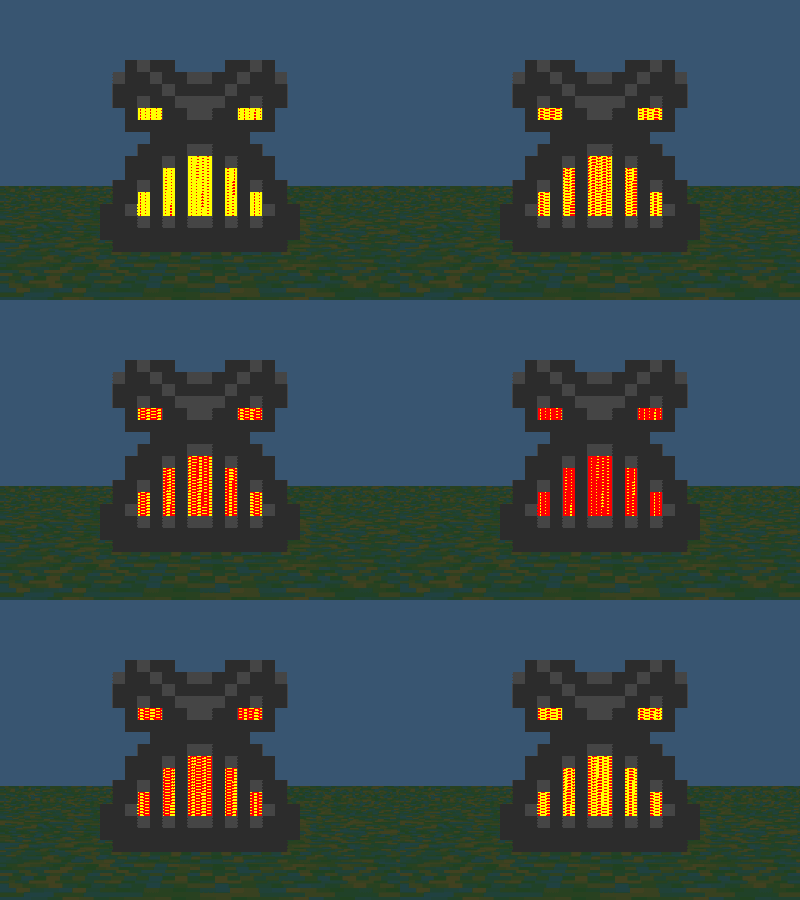
Endbot is a remarkable 256-byte demo that showcases the power of compact coding. This DOS-based program, designed to run via DosBox-X, features a dynamic robot sprite, a growing explosion, a scrolling checkerboard landscape, and a MIDI soundtrack, all packed into a single .com file. To build this demo, you'll need FASM (Flat Assembler) to compile the code into a raw binary. Running it requires specific DosBox-X configurations to ensure proper MIDI emulation.
## Building and Running Endbot
To create the Endbot demo, use FASM to compile the assembly code into a .com file. This process is straightforward, involving a single command without a linker step. Running the demo requires DosBox-X, configured to emulate MPU-401 for MIDI output. The configuration file specifies settings for VGA display, CPU type, and MIDI device, ensuring the demo runs smoothly.
## Code Walkthrough
The code begins by setting up the VGA mode and initializing the timer. The main loop processes each pixel, syncing with the timer to maintain a consistent frame rate. MIDI notes are output at specific intervals, creating a rhythmic soundtrack. The explosion effect is calculated using a clever trick to derive X and Y coordinates from the pixel index, allowing for a smooth, expanding circle.
The robot sprite is animated through a series of bit manipulations, creating the illusion of damage over time. The sprite's movement is controlled by toggling bits of the timer, resulting in a zigzag pattern. The background features a scrolling landscape, achieved through perspective calculations and a checker pattern.
## Data and Size Optimization
The sprite and MIDI data are cleverly combined into a single memory block, with some bytes serving dual purposes. The use of efficient assembly instructions, such as `xlat` for color lookup and `btc` for sprite damage, minimizes the code size. The demo's exit routine is a simple `ret` instruction, leveraging DOS's program termination mechanism to save space.
Endbot exemplifies the art of size optimization, using every byte to its fullest potential. The demo's compact size is achieved through a combination of clever coding techniques and efficient use of DOS and assembly language features.
Key Concepts
Size optimization in programming involves reducing the memory footprint of code and data, often to fit within strict size constraints. This can involve using efficient algorithms, minimizing data usage, and employing compact coding techniques.
Assembly language techniques involve low-level programming methods that directly manipulate hardware resources. These techniques include using specific processor instructions, managing memory addresses, and optimizing code for performance and size.
Category
ProgrammingMore on Discover
Summarized by Mente
Save any article, video, or tweet. AI summarizes it, finds connections, and creates your to-do list.
Start free, no credit card