Exploring Experimental MIDI Features and Sound Manipulation
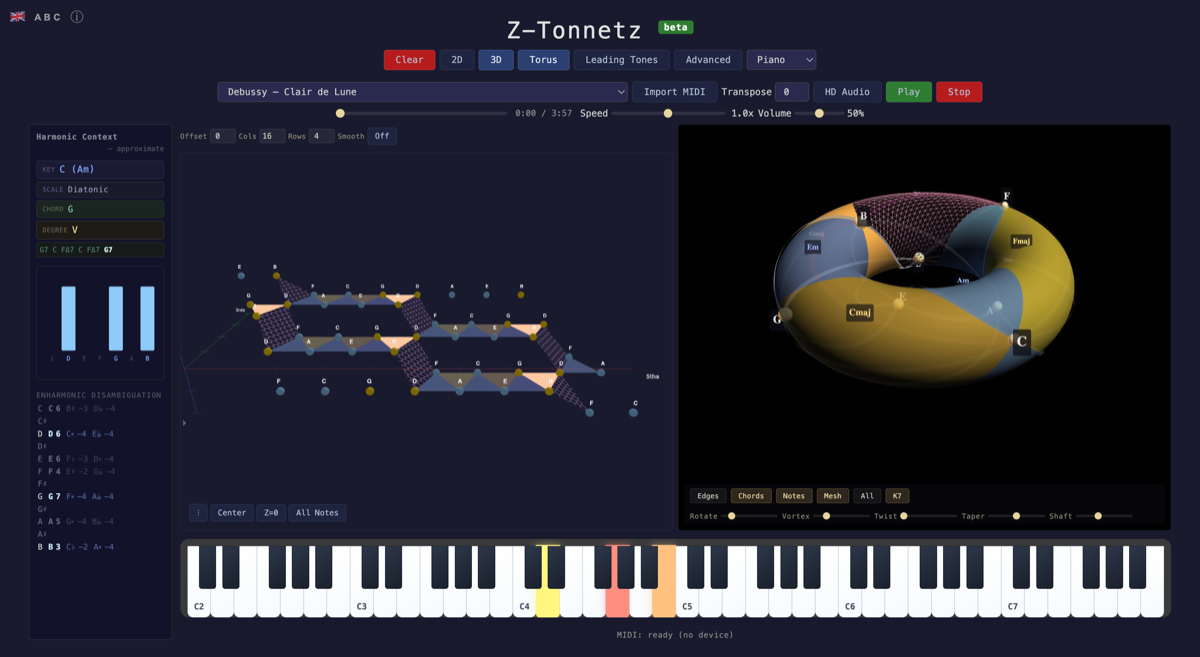
AI Summary
In this article, I delve into the experimental features of MIDI import and transposition, emphasizing that these are still in the early stages of development. I encourage support for this free project as it undergoes further refinement. I explore various aspects of sound manipulation, such as axis direction with fifths and thirds, and the sharpening of harmonic fields. I discuss the importance of budget and competition in sound design, and how resistance and sympathetic activation play roles in the decay of scales and chords.
I also cover the stability of scales and the nuances of grace periods, smooth delays, and chord detection. The intricacies of arpeggiation thresholds and the balance of spread and inertia are examined, alongside bass and context boost settings. Visual elements are not overlooked, with visual smoothing parameters like rise, fall, and floor being crucial for a seamless experience.
Finally, I touch on the use of hue gradients and offset columns and rows to enhance the depth of sound layers. The article provides a comprehensive look at the experimental nature of these features, inviting readers to engage with and support the ongoing development of these innovative sound manipulation tools.
Key Concepts
MIDI (Musical Instrument Digital Interface) is a technical standard that describes a protocol, digital interface, and connectors for connecting a wide variety of electronic musical instruments, computers, and related audio devices. Transposition involves changing the pitch of a musical piece.
Sound manipulation involves altering audio signals to achieve desired effects, which can include changes in pitch, tone, tempo, and other auditory characteristics.
Category
MusicOriginal source
https://ztonnetz.comMore on Discover
Summarized by Mente
Save any article, video, or tweet. AI summarizes it, finds connections, and creates your to-do list.
Start free, no credit card