LIGO Data Reveals Limits on Star-Destroying Supernovae
By John Timmer
AI Summary
As we delve deeper into the cosmos, our understanding of black holes is evolving, much like our initial fascination with exoplanets. The latest analysis of gravitational wave data from LIGO suggests a 'mass gap' in black holes, hinting at the existence of pair-instability supernovae. These cataclysmic events occur when massive stars implode, converting photon energy into electron-positron pairs, destabilizing the core, and triggering a violent explosion that leaves no black hole behind. This phenomenon creates a sharp mass cutoff, with black holes forming only below this threshold.
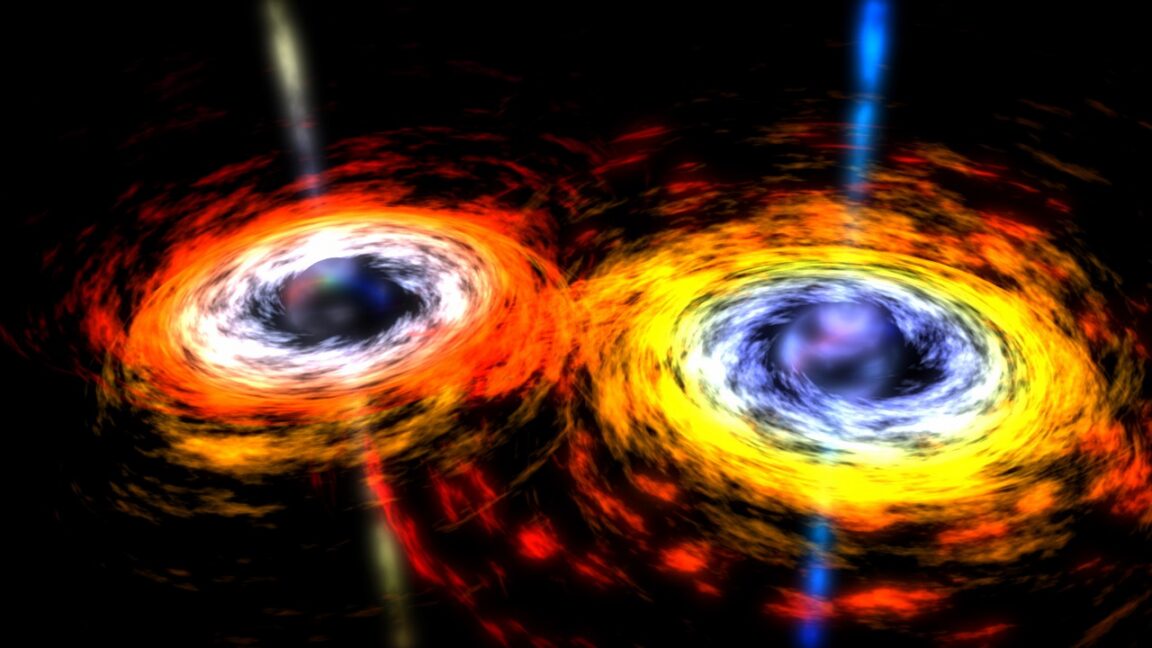
The study identifies three types of black hole mergers: G1-G1, G1-G2, and G2-G2, with G2 black holes resulting from previous mergers. The rarity of G2-G2 mergers is attributed to the energy imparted during collisions, often ejecting the resultant black hole from its cluster. Observations indicate that the smaller black holes in G1-G2 mergers adhere to the mass limit predicted by pair-instability supernovae, around 45 solar masses. This aligns with theoretical predictions and suggests a natural mass limit due to these supernovae.
Moreover, the spins of the larger black holes in these mergers are consistent with those formed from previous mergers, supporting the theory. Although current data shows only one black hole at the upper mass limit of 130 solar masses, ongoing data collection promises to refine these estimates and enhance our understanding of the underlying processes.
The research underscores the potential of gravitational wave astronomy to reveal the intricacies of stellar evolution and the life cycle of massive stars, offering a glimpse into the violent processes that shape our universe.
Key Concepts
A type of supernova that occurs when a massive star's core becomes so hot and dense that photons are converted into electron-positron pairs, leading to a collapse and explosion that leaves no remnant.
The process by which two black holes combine to form a single, larger black hole, often releasing gravitational waves detectable by observatories like LIGO.
Category
ScienceOriginal source
https://arstechnica.com/science/2026/04/black-hole-mergers-put-limits-on-star-destroying-supernovae/More on Discover
Summarized by Mente
Save any article, video, or tweet. AI summarizes it, finds connections, and creates your to-do list.
Start free, no credit card