Lisette: A Rust-Inspired Language Compiling to Go
AI Summary
Lisette is a programming language that draws inspiration from Rust and compiles to Go, offering a unique blend of features like algebraic data types, pattern matching, and a Hindley-Milner type system. It emphasizes immutability by default and seamlessly integrates with Go's ecosystem. The language supports advanced constructs such as enums, pattern matching, and expression-oriented programming, allowing developers to write concise and expressive code.
## Key Features
- **Algebraic Data Types and Pattern Matching**: Lisette supports enums and pattern matching, enabling developers to handle complex data structures with ease. For instance, a `Message` enum can be matched to execute different logic based on its variant.
- **Structs and Implementation Blocks**: Similar to Rust, Lisette allows defining structs and associated methods using `impl` blocks. This feature is illustrated with a `Point` struct that includes a method to calculate the distance between two points.
- **Expression-Oriented Programming**: Functions in Lisette can return values directly from expressions, making code more concise. An example function `describe` uses conditional expressions to determine grades and stars based on a score.
## Advanced Programming Constructs
- **Interfaces and Generics**: Lisette supports interfaces and generics, allowing for flexible and reusable code. The `Metric` interface and a generic `max` function demonstrate how Lisette can handle different types while maintaining type safety.
- **Concurrency and Channels**: Inspired by Go, Lisette provides concurrency primitives like channels and tasks (goroutines). This allows developers to write concurrent programs that can efficiently handle asynchronous operations.
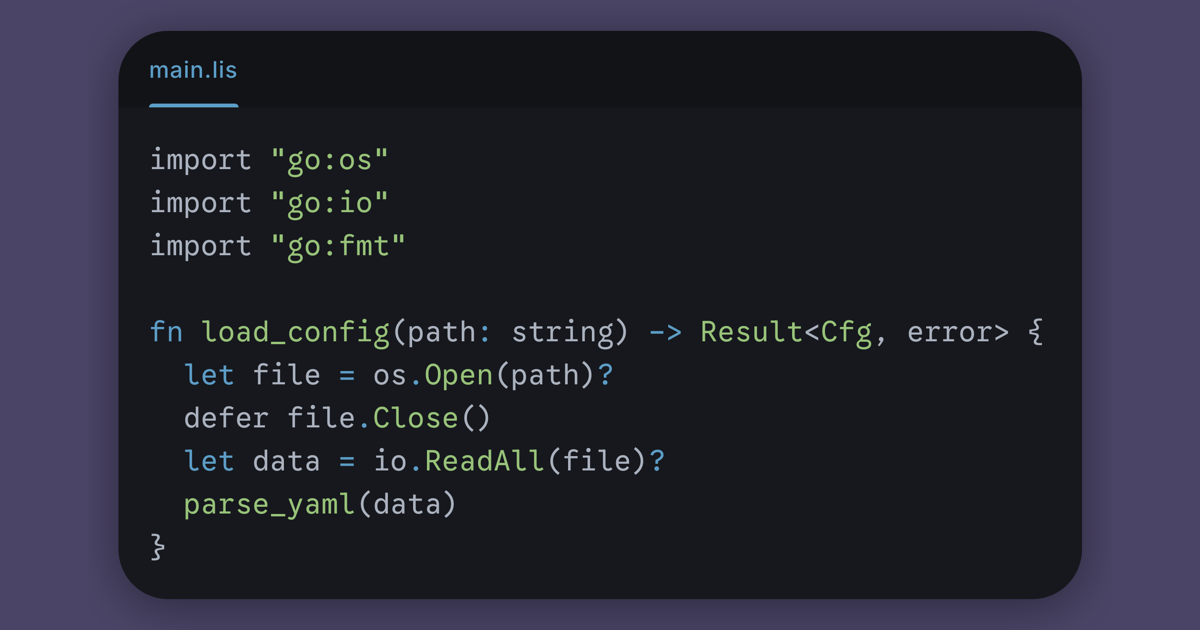
- **Error Handling and Deferral**: Lisette uses `Result` types for error handling, similar to Rust, and supports deferral of operations, ensuring resources are properly managed.
## Compiler Warnings and LSP Support
Lisette's compiler provides helpful warnings and suggestions, such as ensuring all enum variants are handled in match expressions and advising on proper use of immutability. Additionally, Lisette offers LSP support for popular editors like VSCode and Neovim, enhancing the development experience.
Key Concepts
Algebraic data types are a kind of composite type used in programming languages, allowing the combination of other types. They are commonly used to define data structures that can take on different forms, such as enums in Rust.
Pattern matching is a mechanism for checking a value against a pattern. It is a powerful tool in programming that allows for more readable and concise code by directly expressing the structure of the data being handled.
Category
ProgrammingOriginal source
https://lisette.run/More on Discover
Summarized by Mente
Save any article, video, or tweet. AI summarizes it, finds connections, and creates your to-do list.
Start free, no credit card