Listening to the Conversations of Coupled Volcanoes
By By Robin George Andrews
AI Summary
In the realm of volcanology, the discovery of coupled volcanoes has revolutionized our understanding of volcanic activity. This concept first emerged in the 1950s when scientists realized that the catastrophic 1912 eruption in Alaska wasn't solely the work of Mount Katmai. Instead, the eruption's magma had traveled laterally to Novarupta, suggesting a connection between the two volcanoes. This revelation challenged the long-held belief that volcanoes act independently, each with its own magma supply.
Advancements in technology have since enabled researchers to identify other coupled volcanoes worldwide, from Iceland to Japan. These volcanoes, though unique in their pairings, seem to communicate with each other, as evidenced by alternating eruptions. For instance, Iceland's Bárðarbunga and Askja volcanoes demonstrated this phenomenon in 2014, when Bárðarbunga's seismic activity led to an eruption at Askja, 45 kilometers away.
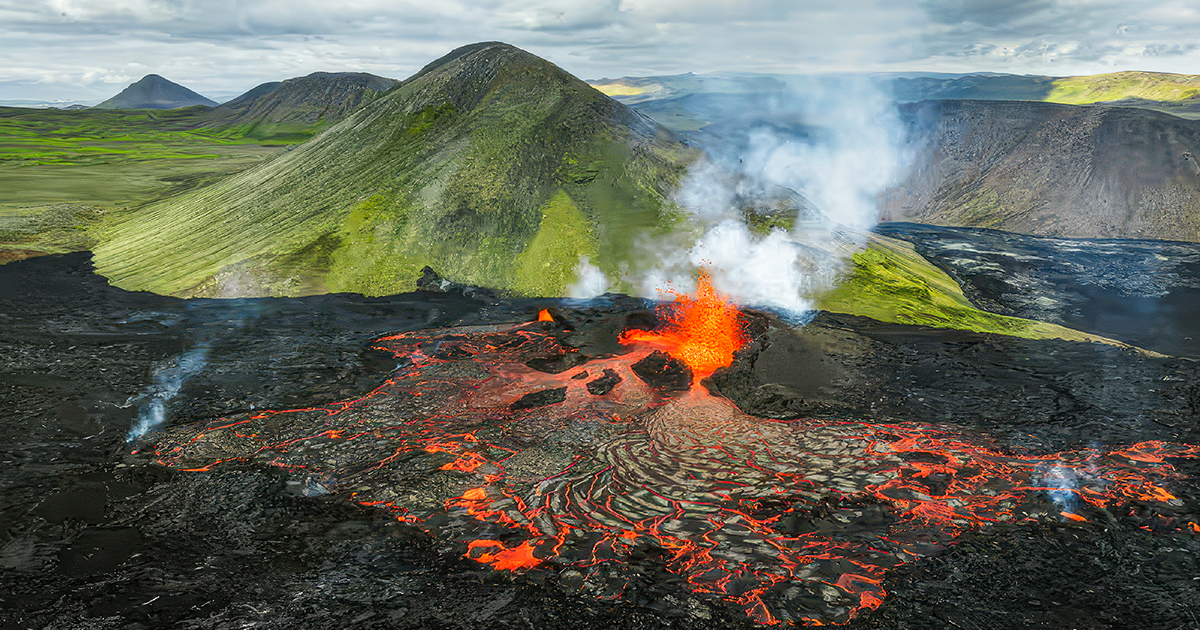
The Reykjanes Peninsula in Iceland provided another example of coupled volcanoes. Between 2021 and 2023, the Fagradalsfjall fissure system erupted multiple times, only for the Svartsengi fissure system to take over in late 2023. This alternating pattern suggests a connection between the two systems, similar to the Bárðarbunga-Askja relationship.
In Hawai‘i, the use of machine learning has uncovered a complex magmatic network linking Kīlauea and Mauna Loa. Despite their distinct lava chemistries, seismic data revealed a shared magma source, challenging previous assumptions about their independence. This discovery highlights the potential for coupled volcanoes to erupt simultaneously or take turns, depending on the dynamics of their shared magmatic heart.
The Greek island of Santorini, with its violent volcanic history, is another site of interest. In 2025, a series of earthquakes and subsequent shrinkage of both Santorini and the nearby Kolumbo volcano suggested a magmatic connection. Data from the Multi-Marex project indicated that magma had risen from great depths, borrowing from Kolumbo's reservoir without reaching the surface.
These findings underscore the importance of monitoring coupled volcanoes to improve eruption forecasts. By understanding the intricate connections between volcanoes, scientists can better predict volcanic behavior and mitigate potential hazards. As research continues, the goal is to map these magmatic conversations and refine our ability to listen to the earth's fiery dialogues.
Key Concepts
Coupled volcanoes are two or more volcanoes that are connected through shared magmatic systems, allowing magma to travel between them. This connection can result in coordinated or alternating volcanic activity.
Magma movement refers to the process by which molten rock travels through the Earth's crust, either vertically towards the surface or laterally between connected volcanic systems.
Category
ScienceOriginal source
https://www.quantamagazine.org/when-coupled-volcanoes-talk-these-researchers-listen-20260327/More on Discover
Summarized by Mente
Save any article, video, or tweet. AI summarizes it, finds connections, and creates your to-do list.
Start free, no credit card