Optimizing the Binary GCD Algorithm for Speed
AI Summary
The greatest common divisor (GCD) of two integers can be calculated using Euclid's algorithm, a method familiar to many from computer science textbooks. This algorithm is efficient, with a logarithmic running time, but it relies heavily on integer division, which is slow on most hardware. An alternative, the binary GCD algorithm, was rediscovered in 1967 by Josef Stein and uses only binary shifts, comparisons, and subtractions, making it potentially faster on modern CPUs.
The binary GCD algorithm leverages properties such as the divisibility of even numbers by two and the relationship between odd numbers and their differences. While initially slower than the standard C++ GCD function due to branching, optimizations can significantly improve its performance. By replacing divisions by two with shifts determined by the number of trailing zeros, and by restructuring the algorithm to minimize branching, the binary GCD can be made nearly twice as fast as the standard implementation.
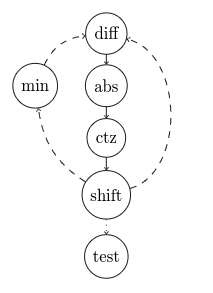
Further optimizations involve analyzing the assembly code to reduce the critical path latency by calculating the count of trailing zeros directly from the difference between two numbers. This approach reduces the dependency chain and allows for faster execution. The final optimized version of the binary GCD algorithm achieves a runtime of 91 nanoseconds, demonstrating the potential for further speed improvements through careful analysis and optimization of the code's execution path.
Key Concepts
A method for finding the greatest common divisor (GCD) of two integers. It works by recursively applying the formula gcd(a, b) = gcd(b, a % b) until b is zero.
An alternative method for computing the GCD that uses only binary operations like shifts, comparisons, and subtractions, avoiding the slow integer division.
Category
ProgrammingOriginal source
https://en.algorithmica.org/hpc/algorithms/gcd/#binary-gcdMore on Discover
Summarized by Mente
Save any article, video, or tweet. AI summarizes it, finds connections, and creates your to-do list.
Start free, no credit card