Porting Mac OS X 10.0 to the Nintendo Wii: A Technical Odyssey
AI Summary
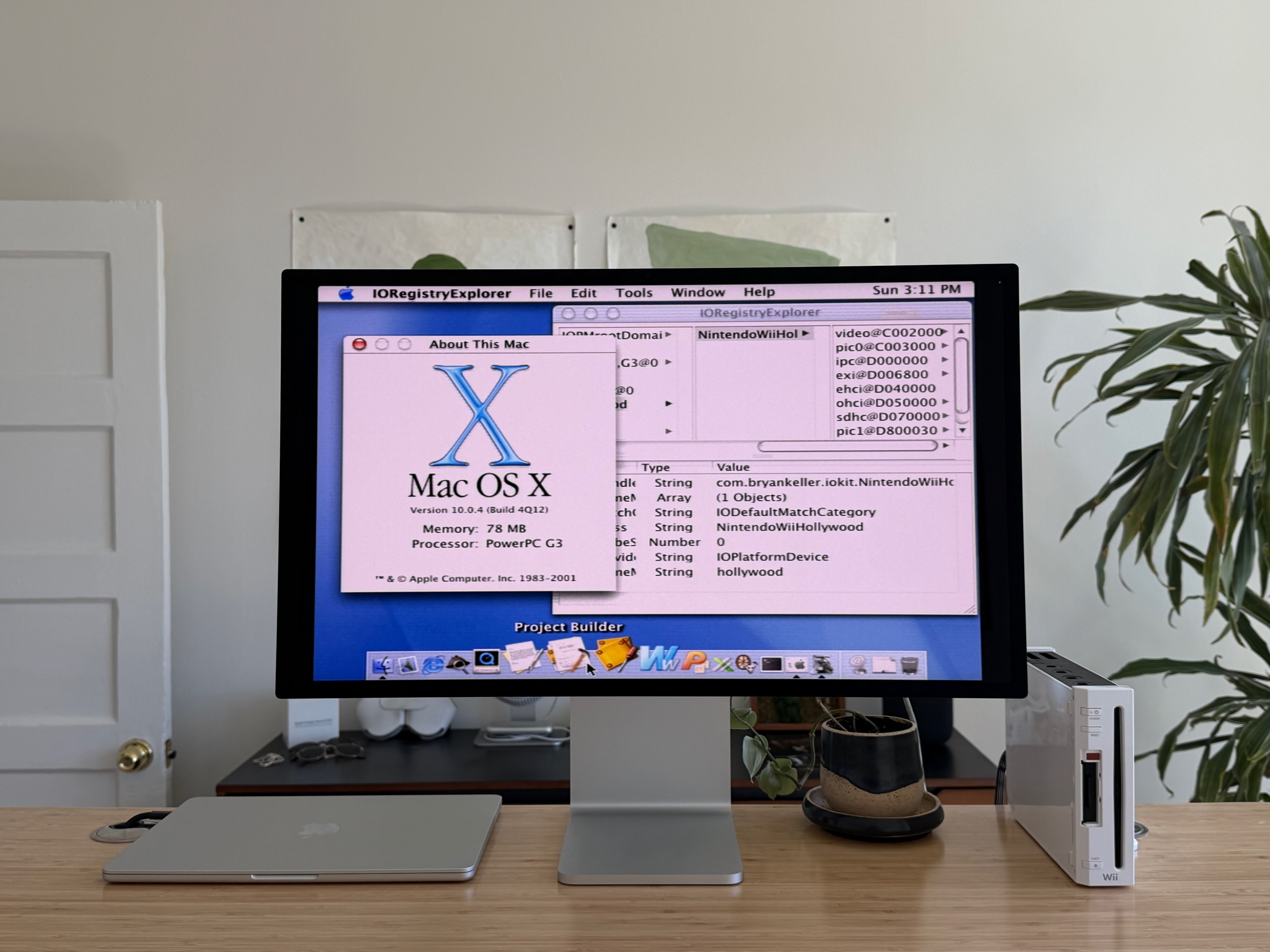
Since 2007, the Nintendo Wii has hosted various operating systems, but now, Mac OS X 10.0 Cheetah joins the list. This project was a journey through the unknown, exploring the Wii's hardware and software compatibility with Mac OS X. The Wii's PowerPC 750CL processor, similar to those in G3 iBooks, provided a promising start. With 88 MB of RAM, split between 1T-SRAM and GDDR3 SDRAM, I confirmed Mac OS X could run with less than the official 128 MB requirement using QEMU.
The software challenge lay in adapting Mac OS X's open-source core, Darwin, to the Wii. PowerPC Macs used Open Firmware, which I bypassed by creating a custom bootloader. This bootloader initialized the Wii's hardware, loaded the kernel from an SD card, and constructed a device tree, crucial for the kernel to recognize the system's hardware.
Writing the bootloader involved using ppcskel, a low-level Wii codebase, to set up the system and load the XNU kernel. Debugging was a creative process, using LED indicators to track kernel progress. The device tree, a hardware map, was hardcoded to match the Wii's consistent hardware setup.
Kernel patching was necessary to adapt XNU's memory management to the Wii's layout. A Mac OS X Cheetah guest on QEMU served as the development environment. Fixing the Block Address Translations (BATs) and rerouting console outputs enabled video and serial debugging.
The next hurdle was writing drivers. IOKit, Mac OS X's driver model, required a custom approach for the Wii's Hollywood SoC, which connects various hardware components. I developed a Hollywood driver to manage these connections and an SD card driver to enable filesystem access, overcoming issues like memory caching.
With the SD card driver working, the system could boot past the 'Still waiting for root device' error. A framebuffer driver was needed for GUI display, converting RGB data to YUV for the Wii's video hardware. Finally, USB support was added by modifying IOUSBFamily to handle the Wii's reversed-little-endian system.
Improvements to the bootloader allowed booting from multiple partitions and loading drivers directly, simplifying the installation process. This project, a decade-long dream, proved that the seemingly impossible is worth pursuing, offering invaluable learning and a sense of achievement.
Key Concepts
The degree to which different hardware components can work together without modification. It involves ensuring that the processor, memory, and other peripherals are compatible with the software intended to run on them.
The ability of software to run on different hardware or operating systems without requiring modification. It often involves ensuring that the software can interact correctly with the hardware and other software components.
Category
TechnologyMore on Discover
Summarized by Mente
Save any article, video, or tweet. AI summarizes it, finds connections, and creates your to-do list.
Start free, no credit card