Reviving Pizza Tycoon: Simplifying Traffic Systems for Efficiency
AI Summary
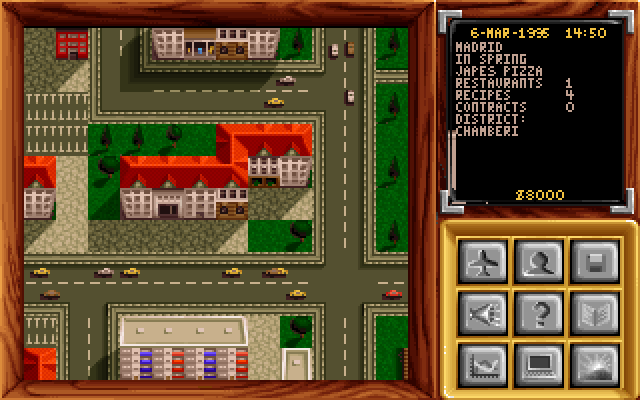
Working on Pizza Legacy, an open-source recreation of the 1994 game Pizza Tycoon, I focused on recreating the game's lively city traffic. Initially, I struggled with overly complex systems, but revisiting the original assembly code with modern tools helped me simplify the process. The key was understanding that cars don't need to know their destination; each road tile dictates direction, creating a network of one-way streets. This simplification allowed cars to move naturally without complex pathfinding.
Cars move one pixel per tick, with a secondary counter ensuring tile-boundary logic only runs once per tile crossed. This staggered approach spreads computational load evenly. Collision detection is straightforward, using pairwise checks to avoid unnecessary calculations, with natural traffic jams forming from simple wait counters. Spawning is based on traffic density, with cars respawning in opposite directions, maintaining a constant flow.
Reflecting on past failures, I realized the original game didn't need advanced pathfinding or physics. By focusing on simple, efficient systems, I recreated the lively city traffic on modern hardware, proving that sometimes, less is more.
Key Concepts
A method of managing traffic flow in simulations or games using basic rules and minimal computational resources, often relying on predefined paths or behaviors.
A computational method used to determine when two or more objects in a simulation or game intersect or come into contact.
Category
ProgrammingOriginal source
https://pizzalegacy.nl/blog/traffic-system.htmlMore on Discover
Summarized by Mente
Save any article, video, or tweet. AI summarizes it, finds connections, and creates your to-do list.
Start free, no credit card