The Lost Dual Pronouns of Old English
By Sophie Hardach
AI Summary
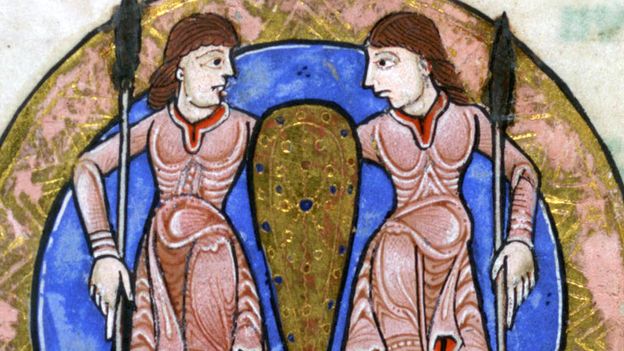
In the rich tapestry of Old English, there once existed a unique set of pronouns specifically for two people, known as the dual form. Words like "wit" for "we two" and "uncer" for "our" captured a special intimacy, reflecting a time when language intricately mirrored human relationships. These pronouns, however, vanished around the 13th century, swept away by the tides of linguistic evolution and societal change.
The dual form's disappearance can be traced back to the simplification of English, influenced by historical events such as the Viking and Norman invasions. These invasions introduced new linguistic elements, like the Old Norse "they," which replaced the ambiguous Old English "hie." The dual pronouns, though poetic and intimate, were deemed unnecessary as the plural "we" sufficed for both two and more people.
Old English was a language rich with grammatical nuances, where even pronouns like "he" and "it" have remained largely unchanged over a millennium. Yet, the dual form, despite its presence in epic tales like Beowulf and poignant poetry such as "Wulf and Eadwacer," did not survive the transition to Middle English.
The shift in pronoun usage was also influenced by the Norman conquest, which brought French linguistic customs to England. The French "vous," used for both singular and plural, gradually replaced the singular "thou" and plural "ye," leading to the universal "you" we use today.
Despite these changes, personal pronouns have shown remarkable stability compared to nouns and verbs. They retain some grammatical features of Old English, like case distinctions, which have otherwise disappeared from modern English nouns.
While the dual form is unlikely to return, its legacy reminds us of the dynamic nature of language and its ability to reflect cultural and social shifts. Perhaps, in a nod to the past, we might revive these lost pronouns in our conversations, celebrating the unique bond of "wit"—just the two of us.
Key Concepts
Dual pronouns are a set of pronouns used to refer specifically to two people or things, distinct from singular and plural forms.
Language simplification refers to the process by which a language becomes less complex over time, often losing grammatical distinctions and adopting more straightforward structures.
Category
HistoryOriginal source
https://www.bbc.com/future/article/20260408-the-extinct-english-words-for-just-the-two-of-usMore on Discover
Summarized by Mente
Save any article, video, or tweet. AI summarizes it, finds connections, and creates your to-do list.
Start free, no credit card