The Seamstresses Behind NASA's Apollo Spacesuits
By The MIT Press Reader
AI Summary
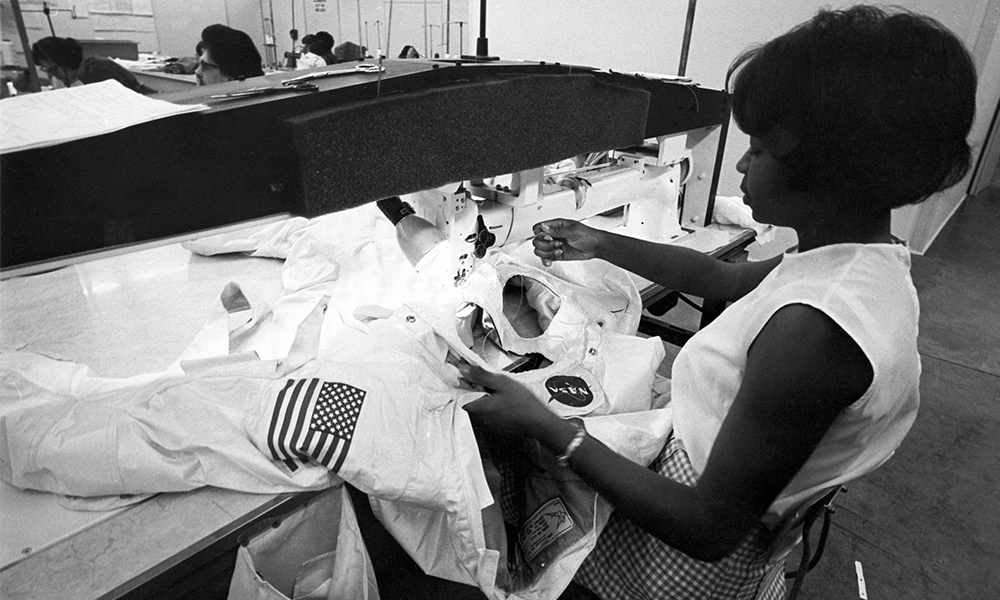
In the 1960s, the International Latex Corporation (ILC), known for making bras and girdles, embarked on an extraordinary journey to craft spacesuits for NASA's Apollo missions. This endeavor required seamstresses to relearn their craft, achieving precision that was literally life-saving. The seamstresses worked with modified sewing machines to stitch layers of fabric with tolerances smaller than a needle's eye, without the aid of traditional tools like pins, which posed risks to the suit's integrity.
ILC's seamstresses, like Roberta Pilkenton, were tasked with assembling the Thermal Micrometeoroid Garment (TMG), a complex 17-layer outer shell, using only their fingers for guidance. Meanwhile, 'gluers' meticulously layered materials like latex, Mylar, and Kapton to create the suit's protective layers, demanding precision down to the thickness of a Mylar sheet.
The company's unique approach extended to the 'dippers' who crafted the suit's flexible rubber sections, a process shrouded in secrecy and reliant on the skilled touch of a few employees. This craftsmanship was complemented by a culture of collaboration, where seamstresses and engineers like Robert Wise worked together to refine suit designs.
Despite their technical prowess, ILC struggled with NASA's bureaucratic demands, particularly in documentation and configuration management. The company initially resisted traditional engineering documentation, favoring patterns and hands-on instructions. This led to conflicts with NASA, which required detailed records for every component of the suit.
To bridge this gap, ILC brought in systems engineers from Ling-Temco-Vought to train their staff, eventually reaching a compromise that allowed ILC's handcrafted methods to coexist with NASA's documentation requirements. This compromise extended to the custom fitting of suits for astronauts, which required a couture-like approach to ensure comfort and functionality.
The Apollo spacesuit, a symbol of human ingenuity, was a testament to the blend of artisanal skill and engineering precision. It highlighted the tension between ILC's intimate craftsmanship and NASA's systematic approach, ultimately proving that the human touch was indispensable in the space race.
Key Concepts
The meticulous and exacting skill required to create complex and reliable products, often involving manual techniques and attention to minute details.
An interdisciplinary approach that focuses on designing and managing complex systems over their life cycles, often involving detailed documentation and configuration management.
Category
Space ExplorationOriginal source
https://thereader.mitpress.mit.edu/the-bra-and-girdle-maker-that-fashioned-the-impossible-for-nasa/More on Discover
Summarized by Mente
Save any article, video, or tweet. AI summarizes it, finds connections, and creates your to-do list.
Start free, no credit card