Understanding Clojure's Persistent Vectors: Basics and Operations
By Jean Niklas hyPiRion L'orange
AI Summary
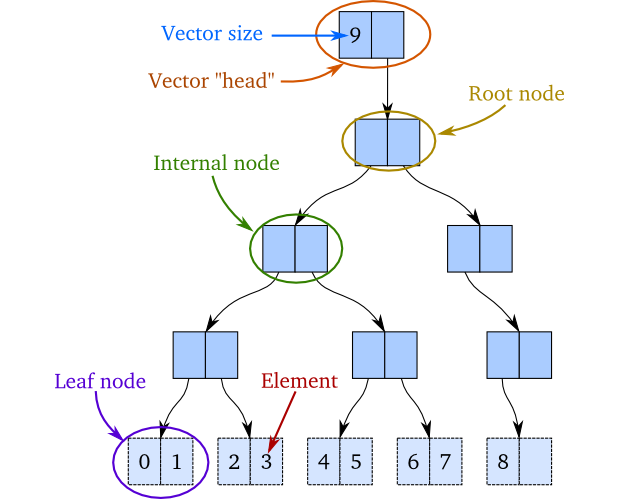
Clojure's persistent vectors, inspired by Phil Bagwell's Ideal Hash Trees, offer nearly constant time operations for appends, updates, and lookups by creating new vectors with each modification, ensuring persistence. Unlike mutable vectors that require copying the entire array for modifications, persistent vectors use a balanced, ordered tree structure, minimizing redundancy and memory usage. The tree's interior nodes reference subnodes, while leaf nodes contain elements, maintaining order and depth consistency.
To update a vector, I walk down the tree to the desired leaf node, copying nodes along the path to preserve persistence. Once at the leaf, I replace the element and return the new vector with the updated path. Appending elements involves similar path copying but includes generating new nodes when necessary, especially when the rightmost leaf node lacks space or the root overflows. In such cases, a new root is created, and the old root becomes its child.
Popping elements, or removing the last element, mirrors appending with three scenarios: removing an element from a leaf with more than one element, handling a leaf with a single element, and dealing with a root containing only one child post-pop. In the latter case, the root is replaced by its child to avoid redundancy.
Despite the operations being theoretically O(log n), Clojure's vectors are effectively constant time due to their shallow tree structure, with a branching factor of 32 per node. This results in trees with a maximum depth of 6 nodes for vectors with less than a billion elements, making them highly efficient.
Future discussions will delve into optimizations, transients, and subvec operations, providing a comprehensive understanding of Clojure's persistent vectors.
Key Concepts
Persistent data structures are those that preserve the previous version of themselves when modified, allowing access to both the new and old versions. They are crucial in functional programming where immutability is a key principle.
Path copying is a technique used in persistent data structures where only the nodes on the path to the modified element are copied, minimizing the amount of duplication required to maintain immutability.
Category
ProgrammingMore on Discover
Summarized by Mente
Save any article, video, or tweet. AI summarizes it, finds connections, and creates your to-do list.
Start free, no credit card