Understanding Spherical Harmonics in Computer Graphics
AI Summary
Embarking on a journey through computer graphics, one inevitably encounters spherical harmonics, a powerful tool for approximating functions on a sphere with a handful of coefficients. These functions are invaluable in modeling complex lighting environments, allowing us to approximate radiance and irradiance efficiently. While spherical harmonics might seem daunting, their practical applications in real-time graphics are accessible with a basic understanding of rendering, linear algebra, and integrals.
## Why Spherical Harmonics Matter
In computer graphics, any function associating a value with a direction in 3D space is a function on a sphere. This is because a direction is represented by a unit vector, whose endpoint lies on a unit sphere. Spherical harmonics allow us to express any continuous function on a sphere as an infinite sum of special polynomials. By truncating this sum, we can approximate complex functions, which is particularly useful for rendering lighting effects.
For instance, the radiance function, which describes light arriving at a point from a direction, is defined on a sphere. Spherical harmonics enable us to approximate such functions with polynomials, simplifying calculations and storage. Beyond lighting, they can approximate other phenomena, like the thickness of a mesh, aiding in effects like subsurface scattering.
## Defining Spherical Harmonics
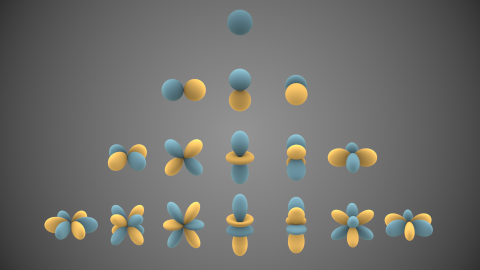
Spherical harmonics form an orthonormal basis for functions on a sphere, meaning any function can be expressed as a sum of these harmonics. They are polynomials, making them easy to evaluate, and their coefficients can be determined numerically. However, practical applications require storing only a finite number of coefficients, which leads to approximations.
## Spherical Harmonic Degree and Order
Spherical harmonics are organized into frequency bands, each with a degree and order. Lower degrees capture broad details, while higher degrees capture finer details. Truncating the infinite sum of harmonics results in losing detail, especially in high-frequency variations. For real-time graphics, degrees up to 2 are often sufficient.
## Practical Implementation
To implement spherical harmonics, one typically uses pre-defined polynomial forms for the basis functions. These functions can be verified for orthonormality using numerical integration. When projecting a cubemap onto spherical harmonics, the coefficients are computed by integrating the product of the cubemap's radiance and the basis functions over the sphere.
## Handling Artifacts
Approximating functions with spherical harmonics can introduce artifacts like ringing, especially with discontinuous functions. This occurs because the finite basis cannot perfectly capture rapid changes. Techniques like windowing, which applies a low-pass filter to the coefficients, help mitigate these artifacts by smoothing the function.
## Applications in Lightmaps
Spherical harmonics are used in lightmaps to store irradiance as a function of surface normal, allowing for detailed lighting effects even with lower resolution maps. This approach enables the baked lighting to react to normal maps, preserving detail and reducing storage requirements.
## Convolution with Spherical Harmonics
Convolution in the context of spherical harmonics simplifies to a per-component multiplication of coefficients. This is particularly useful for computing irradiance, which involves convolving radiance with a clamped cosine function.
## Conclusion
Spherical harmonics offer a robust method for approximating complex lighting environments in computer graphics. While they require careful handling to avoid artifacts, their efficiency and versatility make them a staple in real-time rendering. For further exploration, resources like Peter-Pike Sloan's and Robin Green's papers provide deeper insights into their application and optimization.
Key Concepts
Spherical harmonics are mathematical functions that form an orthonormal basis for functions defined on the surface of a sphere. They allow complex functions to be approximated using a finite set of coefficients.
Function approximation involves representing a complex function using a simpler model, often to facilitate computation or analysis. This can involve truncating an infinite series or using polynomial representations.
Category
TechnologyOriginal source
https://gpfault.net/posts/sph.htmlMore on Discover
Summarized by Mente
Save any article, video, or tweet. AI summarizes it, finds connections, and creates your to-do list.
Start free, no credit card