Understanding the Architecture of Coding Agents and Harnesses
By Sebastian Raschka, PhD
AI Summary
In the realm of coding agents, it's crucial to understand the intricate architecture that allows these systems to enhance the capabilities of Large Language Models (LLMs). Coding agents are not just about the models themselves but about the entire ecosystem that surrounds them, including tool use, context management, and memory. This is why systems like Claude Code or Codex often outperform the same models used in simpler interfaces.
## Components of a Coding Agent
A coding agent is essentially an LLM wrapped in an agentic harness, which is a software scaffold designed to manage context, tools, and execution. This setup is particularly effective for software engineering tasks, where the agent must navigate repositories, manage prompts, and maintain session continuity. The distinction between the model, the reasoning behavior, and the agent product is crucial, as each plays a unique role in the system.
An LLM serves as the core model, generating next-token predictions. A reasoning model, on the other hand, is an LLM trained to perform more complex reasoning and verification tasks. The agent acts as a control loop around the model, deciding on actions, tool usage, and state updates. This layered approach allows for more efficient and effective coding processes.
## The Role of the Agent Harness
The agent harness is the software layer that manages the interaction between the model and its environment. It assembles prompts, tracks file states, applies edits, and manages permissions. This layer significantly shapes the user experience, often making one LLM appear superior to another, despite similar baseline capabilities.
## Core Components of a Coding Harness
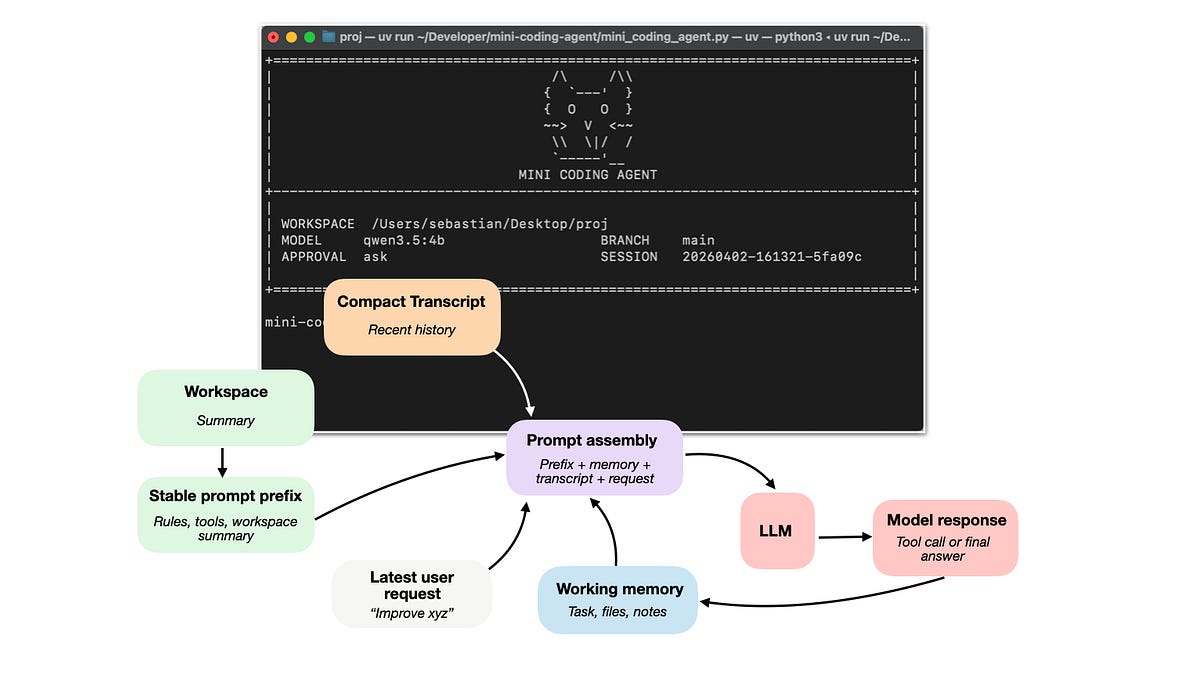
The article outlines six main components of a coding harness: live repo context, prompt shape and cache reuse, structured tools, context reduction, transcripts and memory, and delegation with bounded subagents. Each component plays a vital role in ensuring the agent operates efficiently and effectively.
- **Live Repo Context**: The agent must understand the current state of the repository, including branches and project documents, to execute tasks accurately.
- **Prompt Shape and Cache Reuse**: Efficiently packaging and caching information prevents unnecessary recomputation and maintains session continuity.
- **Structured Tools**: The harness provides a predefined list of tools, ensuring safe and effective command execution.
- **Context Reduction**: Strategies like clipping and summarization manage context bloat, keeping the system efficient.
- **Transcripts and Memory**: A structured session memory maintains a full transcript and a distilled working memory for task continuity.
- **Delegation and Bounded Subagents**: Subagents allow for task parallelization, enhancing efficiency without compromising system integrity.
## Practical Implications
The design of a coding harness greatly impacts the perceived quality of the model. By managing context and tool use effectively, a coding harness can make a reasoning model feel much more powerful than it would in a simpler interface. This is particularly important as LLMs continue to evolve, with harnesses often being the key differentiator in performance.
The article concludes by highlighting the potential of coding agents and harnesses to transform the way we interact with LLMs, making them more than just powerful models but integral parts of a sophisticated system designed for complex tasks.
Key Concepts
A coding agent is a system that uses a Large Language Model (LLM) wrapped in an application layer to perform coding tasks. It includes the model, tools, and a control loop to manage tasks and context.
An agent harness is a software scaffold around a model that manages context, tool use, prompts, state, and control flow. It is essential for the effective operation of coding agents.
Category
ProgrammingMore on Discover
Summarized by Mente
Save any article, video, or tweet. AI summarizes it, finds connections, and creates your to-do list.
Start free, no credit card