Blue Origin's New Glenn Faces Setback Despite Booster Success
By Stephen Clark
AI Summary
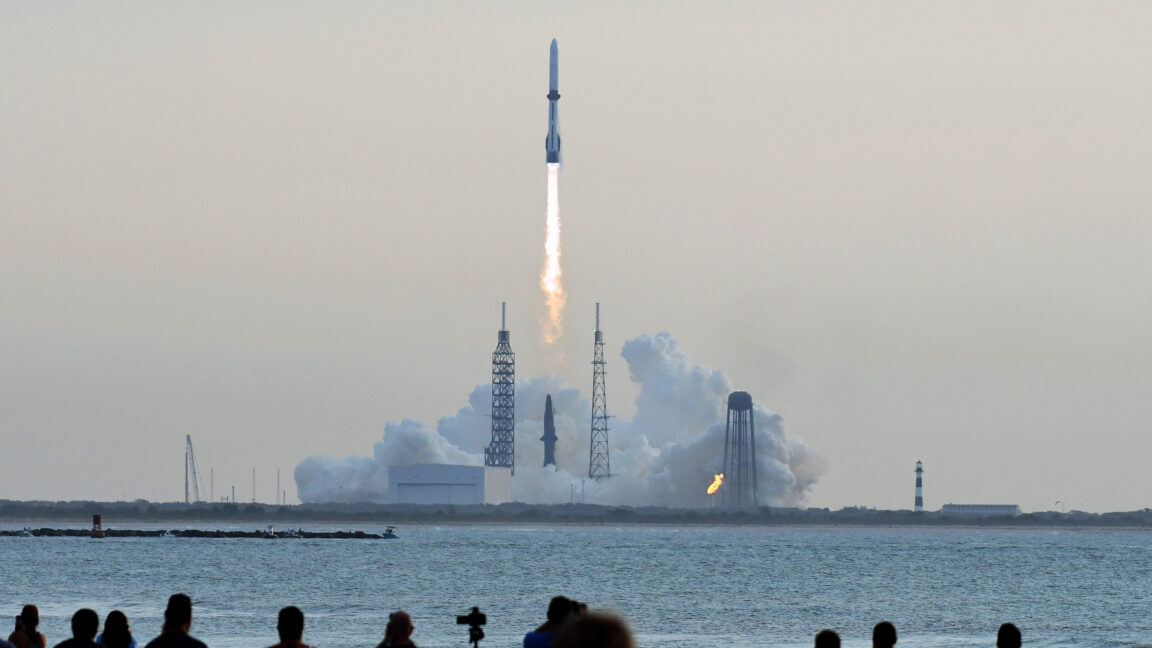
Blue Origin's New Glenn rocket marked a milestone with the successful reuse of its first stage booster, but the mission was marred by a failure in the upper stage. The New Glenn rocket, a key player in NASA's Artemis lunar program, launched from Cape Canaveral, Florida, with its seven BE-4 engines propelling it past the speed of sound. The booster, named 'Never Tell Me The Odds', successfully landed on a recovery ship after its second flight, showcasing Blue Origin's advancements in reusable rocket technology.
However, the mission's success was short-lived as the upper stage failed to place its payload, a cellular broadband satellite for AST SpaceMobile, into the correct orbit. The satellite ended up in an orbit too low for sustainable operations, leading to plans for its de-orbiting. This setback highlights the challenges Blue Origin faces as it competes with SpaceX, which has demonstrated rapid reusability with its Falcon 9 boosters.
The upper stage's failure is a significant blow, especially as Blue Origin aims to increase its launch rate and reliability. The incident mirrors recent upper stage issues faced by SpaceX with its Starship and Falcon 9 rockets. Despite these challenges, Blue Origin continues to push forward, with plans to reuse engines from previous missions and expand its market reach.
AST SpaceMobile, a startup competing with giants like SpaceX and Amazon, relies on Blue Origin and SpaceX for launching its satellites. The company aims to provide global mobile connectivity with a smaller number of larger satellites. Sunday's launch was a critical step in this plan, but the failure underscores the risks involved in space ventures.
The setback could delay upcoming Blue Origin missions, including launches for Amazon's LEO broadband constellation and the Blue Moon lunar lander, crucial for NASA's Artemis missions. As NASA monitors these developments closely, the pressure mounts on Blue Origin to resolve the issues and prove the reliability of its New Glenn rocket.
The broader context of these challenges reflects the competitive and rapidly evolving space industry, where companies like Blue Origin and SpaceX are racing to innovate and capture market share. Despite the setback, Blue Origin's commitment to reusable technology and its role in NASA's lunar ambitions keep it at the forefront of space exploration.
Key Concepts
Reusable rocket technology involves designing rockets that can be launched, recovered, and launched again, reducing the cost and increasing the frequency of space missions.
Space launch reliability refers to the ability of a launch system to consistently deliver payloads to their intended orbits without failure.
Category
Space ExplorationOriginal source
https://arstechnica.com/space/2026/04/errant-upper-stage-spoils-blue-origins-success-in-reusing-new-glenn-booster/More on Discover
Summarized by Mente
Save any article, video, or tweet. AI summarizes it, finds connections, and creates your to-do list.
Start free, no credit card