Orion's Triumphant Return: Astronauts Complete Historic Moon Mission
By Stephen Clark
AI Summary
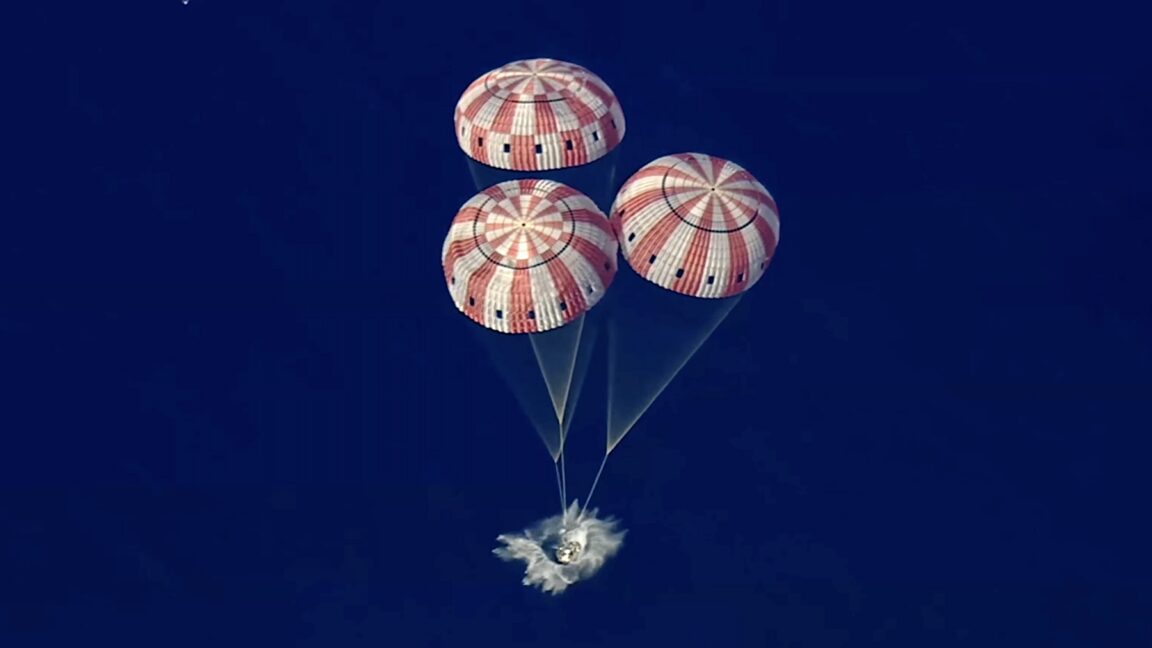
After a thrilling journey that marked humanity's return to the Moon after more than half a century, NASA's Orion spacecraft, aptly named Integrity, made a fiery re-entry into Earth's atmosphere. Traveling at over 30 times the speed of sound, the spacecraft faced extreme temperatures of up to 5,000 degrees Fahrenheit, temporarily losing communication with Mission Control in Houston. As it approached the splashdown zone southwest of San Diego, the spacecraft deployed a series of parachutes to slow its descent, finally landing safely in the Pacific Ocean.
The mission's success was confirmed as communications were restored with Orion's commander, Reid Wiseman, who reported that all four crew members were in good health and spirits. The USS John P. Murtha was on standby to recover the astronauts, who were extracted from the capsule and transported by helicopters for medical evaluations. This mission, part of NASA's Artemis II program, included astronauts Victor Glover, Christina Koch, and Canadian Jeremy Hansen, alongside Wiseman. Their safe return marks a significant milestone in space exploration, paving the way for future lunar missions.
The recovery operation was meticulously planned, with Navy divers assisting the astronauts as they exited the capsule onto an inflatable raft. The team was then flown to the USS John P. Murtha for initial medical checks before heading to San Diego and eventually back to Houston, where they were eagerly awaited by their families. This mission not only demonstrates the technological advancements in space travel but also rekindles the spirit of exploration that drove the original Apollo missions.
Key Concepts
Re-entry dynamics involve the complex processes and physical forces experienced by a spacecraft as it returns to Earth's atmosphere from space. This includes managing extreme heat and deceleration forces.
Space exploration refers to the investigation of outer space through manned and unmanned spacecraft. It aims to discover new information about the universe and develop technology for future missions.
Category
Space ExplorationOriginal source
https://arstechnica.com/space/2026/04/four-astronauts-are-back-home-after-a-daring-ride-around-the-moon/More on Discover
Summarized by Mente
Save any article, video, or tweet. AI summarizes it, finds connections, and creates your to-do list.
Start free, no credit card